Meta’s Oversight Board Reflects on Five Years of Tough Calls
 Adshine.pro12/06/20251 views
Meta’s independent Oversight Board has released a new report to mark its fifth anniversary, offering a detailed look at the cases it has helped Meta and its users navigate, as well as the role it’s played in shaping moderation policies through objective analysis rather than internal directives.
Created as a bold experiment, the Oversight Board was meant to demonstrate how external review could influence policy decisions by shifting authority away from a small circle of Meta executives. The idea was to bring broader expertise and deeper context into decisions that affect speech and behavior across the platform.
And the model has delivered, driving meaningful changes in Meta’s approach to policy and enforcement.
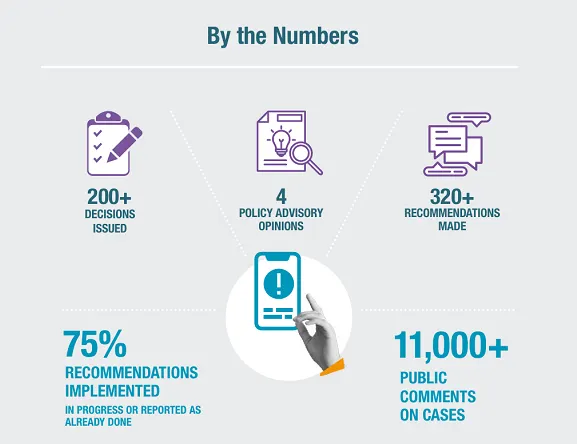
According to the report:
“Five years on, the Board has made important strides for Meta’s global users, bringing transparency, reasoning and a human rights perspective to decisions that were long made behind closed doors, and with little or no public-facing rationale. The model we have built brings experts from around the globe to independently review sensitive content decisions on Meta platforms with input from the public and civil society. Our Board Members are politically, ideologically, geographically, culturally and professionally diverse. This means we can take better account of the varied contexts affecting speech and other human rights in different parts of the world.”
As highlighted in the report, Meta has enacted roughly 75% of the more than 300 recommendations issued by the Oversight Board — a strong indication of its value in providing oversight, structure, and accountability.
Still, skeptics question how truly independent a Meta-funded, Meta-appointed body can be. Yet the board appears to have operated with considerable autonomy, even while relying on the company for financial support.
From the outset, however, the Oversight Board was intended as a test case.
In the wake of heated moderation debates, Meta had publicly pushed for the creation of an external regulatory framework — one that elected governments would design to clearly define what is permissible on social networks. Such a system would relieve platforms from creating their own rules, which inevitably reflect their leaders’ biases to some extent.
The Oversight Board was conceived as a demonstration of what such a model could look like, with the long-term hope that governments worldwide might eventually agree on a unified oversight mechanism governing all major platforms, thereby eliminating concerns about favoritism or internal influence.
So far, no such body has materialized. Instead, governments continue pressuring social networks to regulate content according to their own political interests — a far from ideal scenario. And given the global divide on how moderation should operate and how deeply authorities should be involved, the prospect of reaching a universal agreement appears remote.
Still, the Oversight Board proves such a system is possible and can shape crucial policy across platforms that collectively impact billions. With more political actors seeking to steer or shape online narratives, the need for independent oversight is growing — yet global consensus remains elusive.
For now, platforms will keep making judgment calls on their own, guided by internal standards and business considerations.
It’s a fragile, imperfect solution. And with AI-generated content further complicating the landscape, the road ahead is only getting more tangled.
Centralized governance — as demonstrated by the Oversight Board — can provide clarity. But achieving the wide agreement needed to build a global oversight body still feels out of reach.
📢 If you're interested in Facebook Ads Account, don't hesitate to connect with us!
🔹 https://linktr.ee/Adshinepro
💬 We're always ready to assist you!

