Meta Emerges Victorious in High-Stakes FTC Antitrust War
 Adshine.pro11/19/202514 views
Meta has finally closed the chapter on its years-long showdown with the Federal Trade Commission, after a federal judge ruled that the company did not violate antitrust law when it purchased Instagram and WhatsApp, effectively ending the FTC’s push to force Meta to sell off the two platforms.
The dispute dates back to 2020, when the FTC first launched its lawsuit accusing Meta of unlawfully maintaining a social networking monopoly through “a years-long course of anticompetitive conduct.”
At the heart of the case were two pivotal acquisitions: Instagram in 2012 and WhatsApp in 2014. Regulators claimed Meta bought both platforms specifically to “neutralize competition,” arguing that the deals were designed to shut down rivals rather than foster innovation. As a remedy, the FTC sought to unwind both acquisitions—an unprecedented move that would have reshaped the entire social media landscape.
But in 2021, the lawsuit suffered an early blow when a federal judge dismissed it, noting that the FTC had failed to plausibly demonstrate that Facebook truly held monopoly power. The agency returned with a revised complaint soon after, which was cleared to proceed to trial the following year.
What followed was an extended legal tug-of-war that has stretched on for years. Now, Meta has emerged victorious, effectively eliminating the possibility that its sprawling social ecosystem could be forcibly broken up.
Ultimately, Meta convinced the court that acquiring companies to accelerate product development—rather than attempting to replicate every feature in-house—is a legitimate competitive strategy. The judge also emphasized that the FTC had framed Meta’s competitive landscape far too narrowly, ignoring the presence and growth of formidable players like TikTok and YouTube.
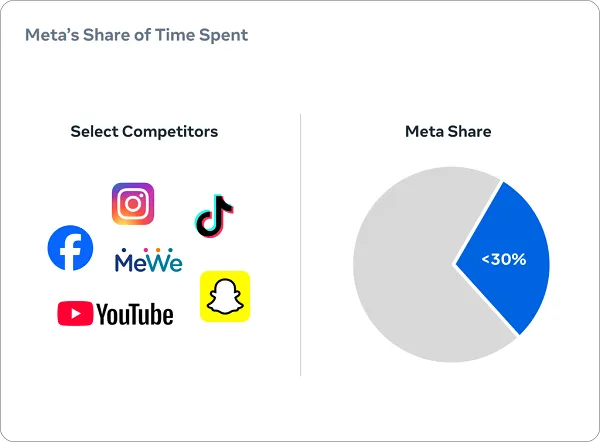
This was always the weak point in the FTC’s argument. Meta had repeatedly argued that regulators were painting an outdated picture of the market by focusing only on smaller competitors like Snapchat and MeWe, while overlooking platforms that now dominate the attention economy.
In truth, TikTok’s meteoric rise has done Meta an unexpected favor: it demonstrated, beyond doubt, that a new entrant can still break through—even in a market supposedly dominated by a single giant.
The court eventually concluded that the FTC’s definition of the competitive landscape was too constrained and failed to convincingly prove that Meta had smothered competition in any meaningful way.
For Meta, it’s a monumental victory. The company can now move forward without the looming threat of being forced to split apart Instagram and WhatsApp. Yet the ruling also raises new questions about the direction of Meta’s long-discussed plan to unify messaging across its apps into one seamless inbox.
For years, Meta seemed committed to integrating Messenger, Instagram DMs, and WhatsApp into a unified system—an effort many observers believed was partially motivated by legal strategy. By tightly fusing its platforms, Meta could make any forced breakup technically and operationally impossible.
But as the company grew more confident in its chances of defeating the FTC, that urgency appeared to fade. Recent signs back that theory: Meta introduced a dedicated inbox for Threads earlier this year, something that would have complicated any unified messaging system. The move suggested that Meta no longer felt the pressure to rush toward total messaging integration.
Still, that’s just one footnote in the broader aftermath. With the antitrust threat now behind it, Meta finally has the runway to advance its long-term strategy without the shadow of government intervention hanging over its head.
📢 If you're interested in Facebook Ads Account, don't hesitate to connect with us!
🔹 https://linktr.ee/Adshinepro
💬 We're always ready to assist you!

