YouTube, Instagram, and TikTok continue to dominate young users
 Adshine.pro12/11/202510 views
As the debate over teen social media use intensifies — punctuated by Australia’s decision to implement an under-16 social media ban — Pew Research has released a new report offering a detailed look at how American teens engage with social platforms and AI tools. The study surveyed more than 1,458 U.S. teens aged 13 to 17, and the findings paint a very clear picture of where young people are spending their time online.
Unsurprisingly, YouTube continues to dominate the teen landscape. An overwhelming majority of teens report using the platform, with TikTok, Instagram, and Snapchat following closely behind.
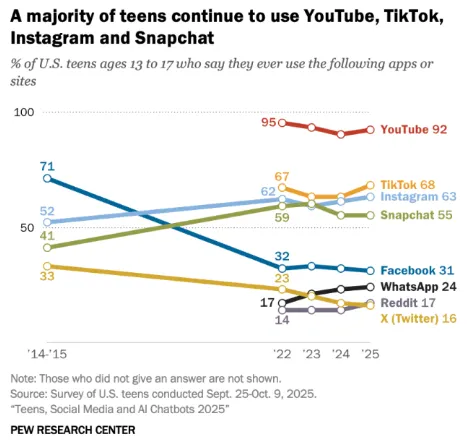
These four apps form the core of teen online activity, while Facebook, WhatsApp, Reddit, and X lag far behind. None of this is shocking — if you asked anyone which platforms teens use today, these would likely be the first names mentioned. What is notable, however, is how steeply Facebook and Twitter/X have declined among younger audiences as they’ve morphed into more adult-heavy spaces that teens no longer find appealing.
For brands hoping to reach a teen audience, the key takeaway is straightforward: focus on these top platforms, and craft content that aligns with how teens actually consume media — particularly short-form video.
The report goes even deeper, highlighting how often teens log into their favorite platforms.
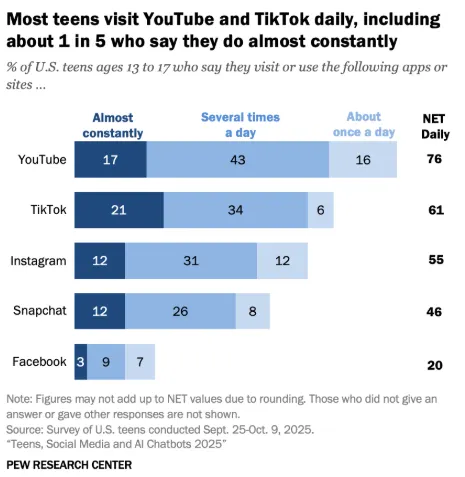
YouTube and TikTok stand out once again, with 21% of teens saying they use TikTok “almost constantly.” TikTok’s hyper-responsive algorithm continues to pull younger users in, keeping them looped into emerging trends and content from creators they follow closely.
This data underscores how deeply TikTok has embedded itself in U.S. teen culture. And with the ongoing uncertainty surrounding the “Protecting Americans from Foreign Adversary Controlled Applications Act,” it raises an important question: what happens to an entire generation of users if TikTok is ultimately banned in the U.S.? With no public indication from Chinese officials about accepting the proposed divestiture, that scenario remains very much on the table.
Pew’s findings also reveal clear demographic splits: teen girls are more likely to gravitate toward TikTok and Instagram, while boys lean more heavily toward YouTube.
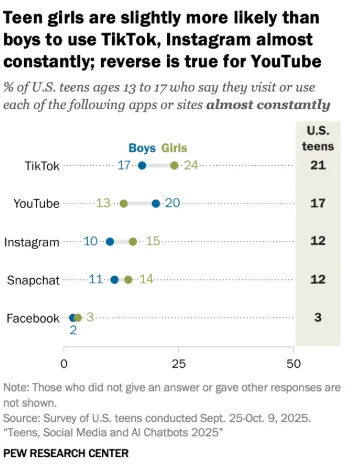
This likely reflects the massive popularity of gaming culture among young male audiences — driven by creators like MrBeast, IShowSpeed, and other streamer-turned-superstars. Even though many of these personalities have branched beyond gaming, their roots and core fanbases remain tightly linked to that ecosystem.
Another striking detail from the report:
“Roughly two-thirds of teens (64%) say they ever use an AI chatbot. Fewer (36%) do not use this tool.”
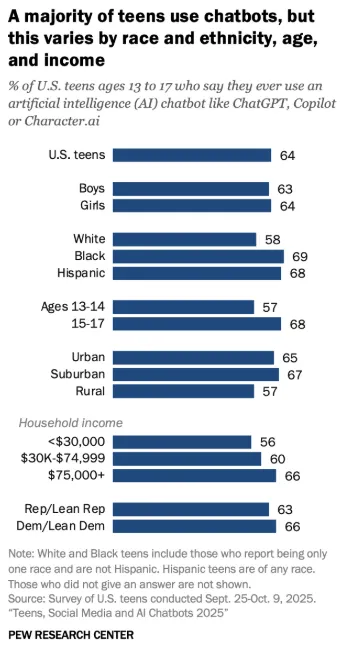
In other words, AI chatbot adoption among teens is rising rapidly. And because this generation is growing up in a world where generative AI is already woven into daily interactions — rather than introduced later in life — it will be fascinating to watch how their expectations and creative behaviors evolve as these systems become even more integrated into online life.
And ultimately, that evolution will likely shape the future of the broader web itself.


